
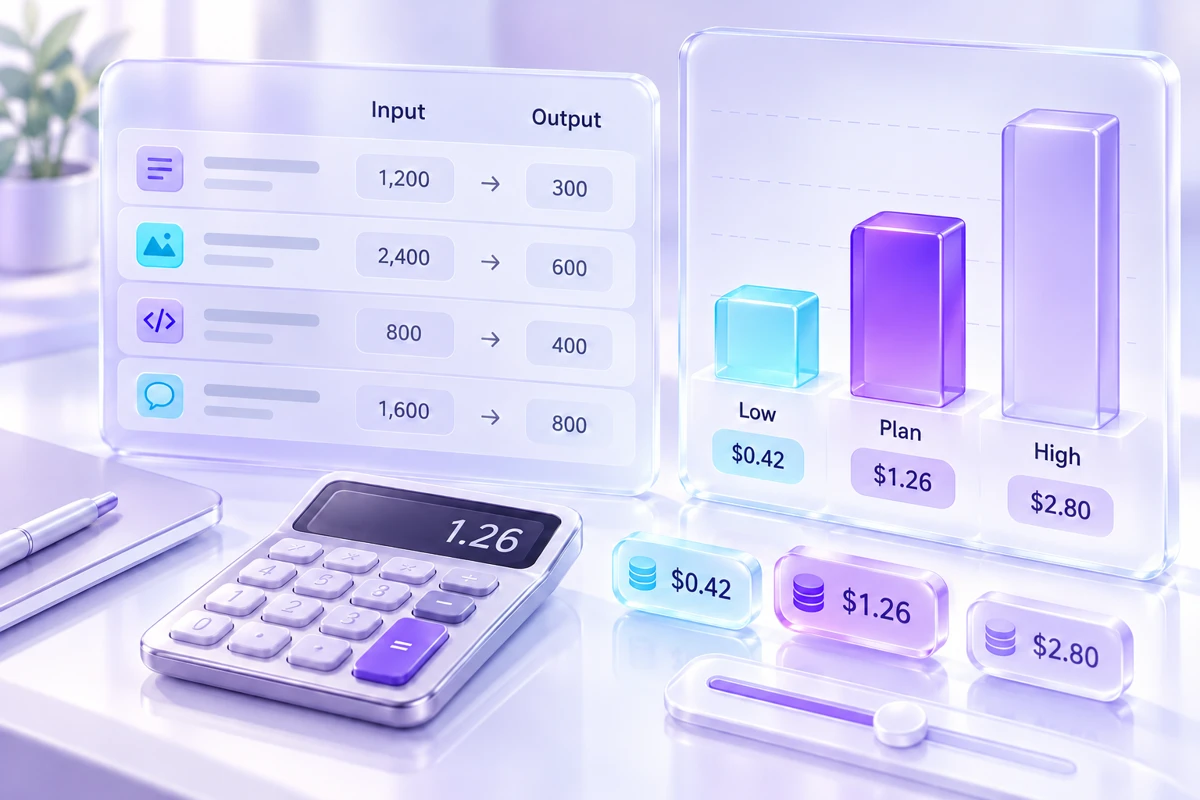

A useful cost estimate explains where its numbers came from. It does not need to predict the invoice perfectly, but it should show task volume, input and output usage, retries and fixed fees separately. That makes it possible to revise the estimate when the workflow changes rather than starting again from a single unexplained total.
Define one completed task Choose the unit of work. A customer-update workflow might contain one call to extract facts and another to draft the message. Count those calls as separate stages within one completed task. If you count each stage as a task and then multiply by the number of stages again, the estimate will be inflated.
Record the expected monthly task volume and a low and high scenario. These are planning assumptions, not forecasts backed by historical evidence unless you actually have that evidence. Label them accordingly.
Enter usage and rates separately For each stage, estimate input and output tokens from representative examples. Use the provider’s rate units consistently, such as a price per million tokens. Record the source URL and date of the rate you entered. A pasted number without its unit is easy to misread later.
Keep subscription fees separate from API usage charges. A chat subscription does not automatically describe how a separately billed API workflow is charged. Use the pricing terms for the actual service and account you intend to run.
Make retries visible In a fictional planning example, suppose you expect 1,000 completed tasks and an average of 1.2 attempts per task. That means budgeting for 1,200 attempts, not adding 20 retries to the entire month. State whether a retry repeats the whole workflow or only one stage.
Do not add a retry allowance twice. If the measured usage already includes retries, either use that measured average or model retries separately. Mixing both approaches can produce a convincing but misleading total.
Treat caching as an assumption to verify If the service has a different cached-input rate, distinguish the eligible cached portion from ordinary input. Not every repeated word necessarily receives that rate. Your estimate should make the assumed share visible so you can set it to zero when the conditions are not established.
As an arithmetic exercise, imagine 1,200 attempts with 1,000 input tokens and 500 output tokens each. At fictional rates of $2 per million input tokens and $8 per million output tokens, uncached usage would be $7.20. These are invented rates for checking the formula, not a current provider quote.
Include the work around the call Add fixed platform fees or other known charges in separate rows. Keep human review effort visible in your decision even if your worksheet tracks only software cost. A cheaper response that requires extensive correction may not be the better workflow.
After a trial period, compare the estimate with the provider’s usage report. Investigate differences in task count, output length, retries and cached usage. Save the revised assumptions with their dates. The most valuable estimate is one you can explain and update, with a low and high range that shows which assumptions deserve attention before the workflow grows.
Keep the inputs and review notes together in the ai workflow cost planner workspace, then save a backup you can reopen.